What is Diastasis Recti?

Diastasis Recti is the separation of your abdominal muscles that occurs during pregnancy as the baby grows & stretches the linea alba (connective tissue down the center of your abs). It’s a natural adaptation of pregnancy.
The images below provide an example of what the core muscles and linea alba might look like before pregnancy (far left), during pregnancy (middle), and after pregnancy (far right).
In the middle picture, you can see the natural stretching along the linea alba during pregnancy. In the image to the right, which represents postpartum, you can see the core has mostly recovered, but not 100%. This is totally normal and the amount of remaining separation/laxity will be different for everyone & will change a lot in the first 6 months-1 year postpartum.

First, let’s talk about how you can check yourself for diastasis recti. Check out the YouTube video below.
Around the belly button is the most common place to have the widest separation, but some people have a separation up higher or down lower. You’re typically considered to have a diastasis recti (DR) when the separation between your rectus abdominus muscles is greater than 2cm (approximately 2 fingers) at any point along the midline AND the depth is greater than ~1 knuckle.
Here’s what to consider at if you’re checking yourself for DR:
The width of the gap (>2 fingers?) at the belly button, above it, and below it.
The depth of the gap (how far down do my fingers sink)
How much tension can you create. Exhale & perform a core brace, then check again. Does the depth of the gap decrease? Can you create tension, or do my fingers still go as deep? Does the tissue feel more firm?
Now for the big question; what do you do about diastasis recti?
Step 1: don’t panic! Too many women are told they will never do XYZ exercise again because they have a diastasis recti. I have one (that first image is my belly) and I am able to do anything my heart desires, including sit-ups and planks 😊.
Step 2: learn to breathe diaphragmatically. This means on the inhale, you feel your rib cage, abs, and pelvic floor expand in 360 degrees. On the exhale, you feel everything come back towards your spine & contract slightly.
Here are a few signs you could work on your breathing pattern:
Belly expands/pushes out on the exhale. That should happen on the INHALE.
Only your belly moves, with no movement in your rib cage.
Your shoulders shrug up towards your ears on the inhale.
If you notice any of these things (it can be helpful to video yourself), an important part of your diastasis recti healing may be working on your breathing pattern.
Step 3: learn to expand your rib cage where it is compressed. We all have compression somewhere in our rib cage because we are human and we all move through the world differently. What I find with most pregnant/postpartum women is that they have a lot of compression on the back side of their rib cage.
This comes from the baby pressing up on the diaphragm & ribs during pregnancy, cause the front of the rib cage to flare (top red line in the pregnant image below). The weight of the baby as it grows also pulls the center of gravity forward, resulting in in more of a pronounced arch in the lower back as the pelvis tips forward (bottom red line in the pregnant image below). You can see the area of added compression, especially in the low to mid back. Again, all common & normal adaptations of pregnancy.
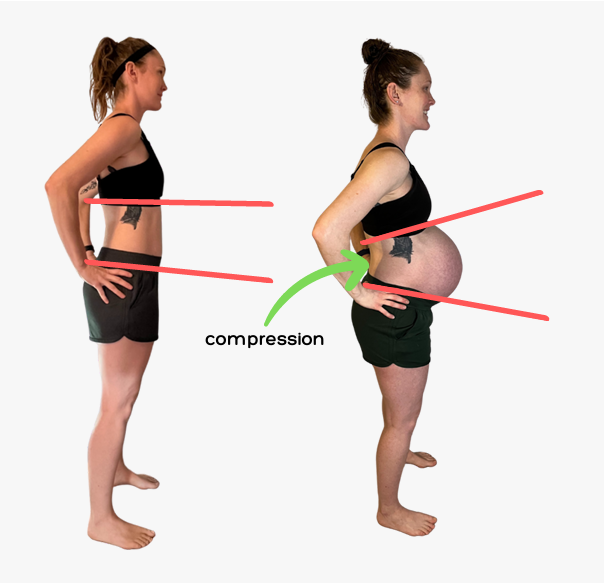
But it can be helpful to address this compression via positional breathing exercises where you compress the front of the rib cage & expand the back, like this one. If you can reduce the compression in the back of your rib cage, you can leverage your core muscles better (they won’t be on stretch all of the time), which will allow you to more easily strengthen them.
Step 4: progressively challenge your core. If you’re just starting your diastasis recti rehab journey, start with things like coordinating your breathing with heel slides, deadbugs, and bird dogs. Coordinating the breathing & learning how to create and maintain a strong core brace is important. It’s also important to incorporate movements in all planes of motion, like these banded thoracic rotation & adductor stretch side bends.
But these movements do not have to be your only core work!! Think of them as more “supplemental” to your core strength training.
Because the truth is, tissues need tension to get stronger. You HAVE to start doing more challenging movements. Don’t be afraid of movements like sit-ups and planks. Honestly, don’t be afraid of coning & doming in general! Did you know there is actually no research proving that coning/doming make diastasis recti worse.
Now for a difficult topic…
Diastasis isn’t as big of a deal as people make it.
This might be an unpopular opinion, but I don’t think diastasis recti is as big of a deal as people make it. I don’t think it’s fun to watch your body change & to feel like you’re living in a foreign body. I have experienced both of those things! But I do think it’s a great opportunity to learn how your core functions & spend some time focusing on your breathing & rib cage mobility. This will actually help make you stronger in the long run.
DR is definitely not the ab death sentence some people make it out to be. You’re not broken & you can get back to all of the things you want to do again.
If you’re looking for a program that works on everything covered in this, you really should check out my “Core & More” program - it’s a 6 week program that starts with the basics, but builds to some pretty challenging core exercises by the end! It’s one of my favorites to help you feel coordinated, connected & strong.
You can purchase it (lifetime access) via my app, OR you can do the coach-led version via my membership (37/month).